
Sarclisa Escena (isatuximab-irfc) for multiple myeloma
 Fact-checked by
 What is Sarclisa Escena for multiple myeloma?
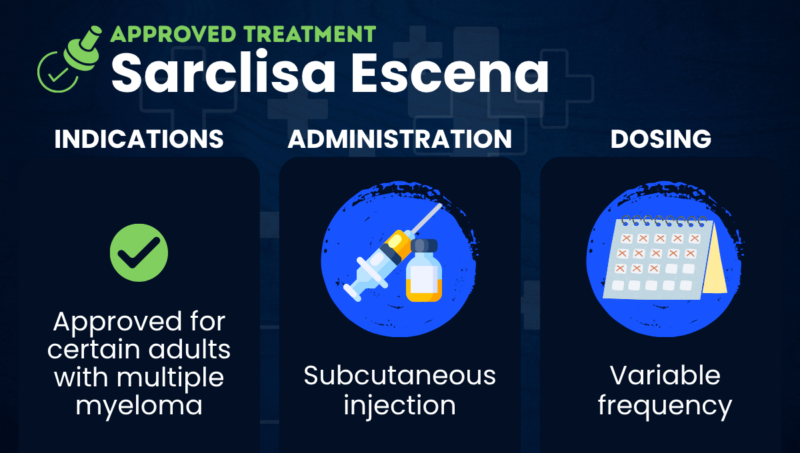
Sarclisa Escena is an antibody-based therapy approved to be used as part of several treatment regimens for adults with multiple myeloma. Eligible patients include those newly diagnosed and those with relapsed or refractory multiple myeloma (RRMM), in whom the cancer has returned or has not responded to prior treatment.
Multiple myeloma is a type of blood cancer that affects immune cells called plasma cells, causing them to grow out of control. Sarclisa Escena aims to kill these cancerous cells by targeting CD38, a protein found at high levels on their surface. This strategy, called CD38 inhibition, involves using an antibody that’s specifically designed to bind to CD38 and promote cancer cell death.
Sanofi developed Sarclisa Escena as an alternative formulation of Sarclisa, the original, into-the-vein (intravenous) formulation that is also approved as part of several treatment regimens for adults with multiple myeloma. The therapies have the same active ingredient, but unlike Sarclisa, Sarclisa Escena is delivered via an under-the-skin (subcutaneous) injection. The medication can be administered using either a traditional syringe and infusion set or an on-body injector (OBI) device called CirCLIQ OBI.
Therapy snapshot
| Brand name | Sarclisa Escena |
| Chemical name | Isatuximab-irfc |
| Usage | Used in combination with other therapies to treat certain adults with multiple myeloma |
| Administration | Subcutaneous injection |
Who can take Sarclisa Escena?
In the U.S., Sarclisa Escena is approved to be used as part of several treatment combinations for adults with multiple myeloma. Specifically, it can be used:
- with Pomalyst (pomalidomide) and the corticosteroid dexamethasone for people with multiple myeloma who have received at least one prior round of therapy, including Revlimid (lenalidomide) and a proteasome inhibitor
- with Kyprolis (carfilzomib) and dexamethasone for people with RRMM who have received one to three prior rounds of therapy
- with Velcade (bortezomib), Revlimid, and dexamethasone for people with newly diagnosed multiple myeloma who aren’t eligible for a stem cell transplant
People who have experienced allergic reactions to isatuximab-irfc, the active ingredient in Sarclisa and Sarclisa Escena, or any other ingredients in the therapy’s composition should not use the medication, per the prescribing information.
The use of Sarclisa Escena in combination with Pomalyst or Revlimid is contraindicated during pregnancy due to the risk of fetal harm or death.
How is Sarclisa Escena administered?
Sarclisa Escena is administered by healthcare providers as a subcutaneous injection into the abdomen, using either a traditional syringe and infusion set or the CirCLIQ OBI. Manual administration using a commercially available syringe and infusion set typically takes about 6 minutes. With the CirCLIQ OBI, administration takes longer — usually around 20 minutes — but the injection is delivered automatically with a press of a button after a healthcare provider properly places the device. The recommended dose is 1,400 mg.
Generally, Sarclisa Escena is administered in 28-day (four-week cycles). During the first cycle, patients receive weekly injections. For subsequent cycles, injections are typically given every other week. After completing 12 cycles of treatment, some people with newly diagnosed multiple myeloma may continue to receive injections once every four weeks. Treatment typically lasts until disease progression or unacceptable toxicity.
During at least the first treatment cycle, healthcare providers will also administer medications to reduce the risk and severity of allergic and administration-related reactions.
Sarclisa Escena in clinical trials
Three main clinical trials supported the approval of Sarclisa Escena in the U.S.:
- IRAKLIA (NCT05405166), a Phase 3 trial that assessed the safety and efficacy of Sarclisa Escena when compared with the original Sarclisa. The trial enrolled 531 patients with RRMM who received either Sarclisa Escena or Sarclisa in combination with Pomalyst and dexamethasone. Results showed that the combinations of Sarclisa and Sarclisa Escena had comparable efficacy. The overall response rate (ORR), or percentage of participants who responded at least partially to treatment, was 71.1% for those receiving Sarclisa Escena and 70.5% for those on Sarclisa.
- The Phase 2 IZALCO study (NCT05704049) assessed the safety and efficacy of Sarclisa Escena when given alongside Kyprolis and dexamethasone to 74 RRMM patients who had previously received one to three lines of treatment. In the study, Sarclisa Escena was administered using the traditional manual method and the CirCLIQ OBI. After a median follow-up of 10.1 months, the ORR was 79.7%. Both methods of administration resulted in similar exposure to the therapy’s active ingredient, though about three-quarters of the participants said they preferred the OBI method. A follow-up analysis showed that 61.5% of participants were alive and had not experienced disease progression after 18 months.
- ISASOCUT (NCT05889221), an investigator-initiated Phase 2 trial, included 74 participants with newly diagnosed multiple myeloma who weren’t eligible for a stem cell transplant. They received 12 cycles of Sarclisa Escena given alongside Velcade, Revlimid, and dexamethasone as part of induction treatment. From cycle 13 onward, patients entered a continuous treatment period, where they received Sarclisa Escena in combination with Revlimid until disease progression or unacceptable toxicity. After a median follow-up of 12 months, the ORR was 97.3%.
Sarclisa Escena side effects
The side effects of Sarclisa Escena vary depending on the treatment regimen. In general, possible side effects can include:
- upper respiratory tract infections
- fatigue
- pneumonia
- muscle and bone pain
- diarrhea
- damage to the nerves outside the brain and spinal cord (peripheral neuropathy), which can cause changes in sensation or movement
- constipation
- injection site reactions
- insomnia
- swelling (edema)
- rash
- skin redness
Sarclisa Escena can also cause changes in blood parameters, including decreases in:
- the number of white blood cells, which are important for immune function
- the number of platelets, the cell fragments that help form blood clots
- the levels of hemoglobin, a protein that helps red blood cells carry oxygen throughout the body
Throughout treatment, people taking Sarclisa Escena will also be monitored for potentially severe side effects, including allergic and administration-related reactions, low numbers of a type of white blood cells called neutrophils, infections, and new, unrelated forms of cancer.
The active ingredient in Sarclisa Escena may interfere with the results of certain types of blood tests. These include tests that assess if a blood donor and transfusion recipient have compatible blood types, and others that help monitor responses to myeloma medications.
Sarclisa Escena may be harmful to a developing fetus. Female patients with productive potential should use an effective method of contraception while being treated with the medication and for seven months after the last dose.
Rare Cancer News is strictly a news and information website about the disease. It does not provide medical advice, diagnosis, or treatment. This content is not intended to be a substitute for professional medical advice, diagnosis, or treatment. Always seek the advice of your physician or other qualified health provider with any questions you may have regarding a medical condition. Never disregard professional medical advice or delay in seeking it because of something you have read on this website.