
Lynozyfic (linvoseltamab-gcpt) for multiple myeloma
 Fact-checked by
 What is Lynozyfic for multiple myeloma?
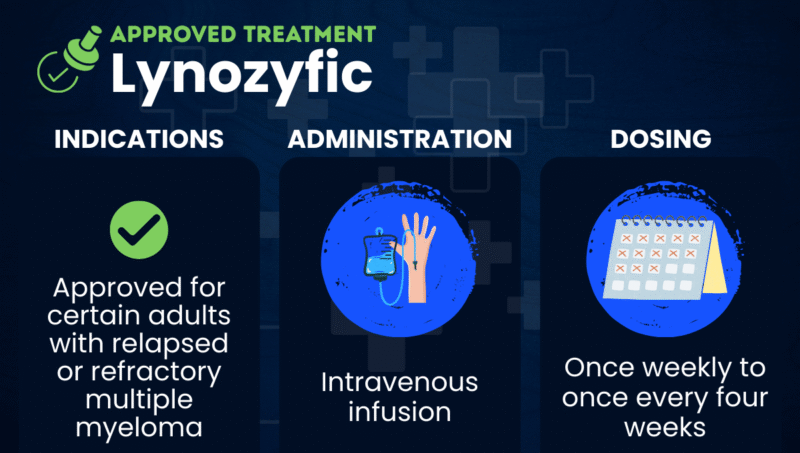
Lynozyfic (linvoseltamab-gcpt) is an approved antibody-based therapy for certain adults with multiple myeloma that has returned (relapsed) after or proven unresponsive (refractory) to previous lines of treatment. The therapy’s approval in the U.S. and the European Union is provisional, meaning that additional evidence of the medication’s effectiveness is required for its full continued approval.
In multiple myeloma, immune plasma cells become cancerous and start growing out of control in bone marrow, the spongy interior of some bones. Although the immune system has natural anticancer defenses, including T-cells that can kill cancer cells, the malignant plasma cells, or myeloma cells, often evade these defenses.
Lynozyfic is designed to help T-cells target and destroy myeloma cells more efficiently. The medication is a bispecific antibody that binds to two proteins simultaneously — specifically, the CD3 protein on T-cells and the B-cell maturation antigen (BCMA) protein on myeloma cells. By binding to CD3 and BCMA, Lynozyfic activates T-cells and brings them into close contact with the myeloma cells they need to eliminate. This is expected to help control multiple myeloma in some patients.
Regeneron Pharmaceuticals is developing and marketing Lynozyfic, which is administered via into-the-vein (intravenous) infusions. The company is now sponsoring clinical trials that, if successful, could support the therapy’s full approval in the future.
Therapy snapshot
| Brand name | Lynozyfic |
| Chemical name | Linvoseltamab-gcpt |
| Usage | Used to treat certain adults with relapsed or refractory multiple myeloma |
| Administration | Intravenous infusion |
Who can take Lynozyfic?
In the U.S., Lynozyfic’s accelerated approval covers adults with relapsed or refractory multiple myeloma (RRMM) who have previously received at least four lines of therapy, including a proteasome inhibitor, an immunomodulatory drug, and an anti-CD38 antibody.
In the European Union, Lynozyfic’s conditional approval is for a similar indication.
Lynozyfic’s U.S. prescribing information lists no contraindications to its use. However, it carries a boxed warning for potentially serious or life-threatening side effects, including severe inflammatory responses and neurological complications. As such, the therapy is only available in the U.S. through a restricted distribution program called Lynozyfic Risk Evaluation and Mitigation Strategy (REMS).
How is Lynozyfic administered?
Healthcare providers administer Lynozyfic as an intravenous infusion in a clinical setting. Dosing occurs in three to four phases:
- Step-up dosing: Over two weeks, patients receive three gradually increasing doses of Lynozyfic, each administered by infusion over about four hours. The third infusion contains the full recommended dose, which is typically 200 mg.
- Weekly dosing: There may be one week after the step-up period during which patients receive the full dose in an infusion lasting about one hour. After this, they receive 10 weekly infusions, usually lasting about 30 minutes (though this may vary depending on side effects).
- Every-other-week dosing: For five additional doses, infusions will be administered every two weeks.
- Possible every-four-weeks dosing: After the first three phases, which generally last about six months in total, doctors will assess how well the cancer is responding to treatment. If the response is sufficient, they may decrease dosing to once every four weeks or continue every other week.
Lynozyfic in clinical trials
Lynozyfic’s accelerated approval in the U.S. was supported by data from the Phase 1/2 LINKER-MM1 clinical trial (NCT03761108), which included adults with RRMM who had previously received at least three lines of therapy. Data showed that:
- among the 80 patients who had received at least four prior lines of therapy and made up the study’s efficacy population, 70% had at least a partial response to treatment
- patients started responding within a median of approximately one month after beginning treatment
- among responders, 72% were predicted to continue responding to treatment at one year
Other clinical trials in the LINKER program are currently evaluating Lynozyfic in various clinical settings. These include:
- LINKER-MM2 (NCT05137054), a Phase 1 trial evaluating several combinations of Lynozyfic and other medications in people with RRMM
- LINKER-MM3 (NCT05730036), a Phase 3 trial assessing the safety and efficacy of Lynozyfic against a combination of Empliciti (elotuzumab), Pomalyst (pomalidomide), and dexamethasone in adults with RRMM
- LINKER-MM4 (NCT05828511), a Phase 1/2 trial testing Lynozyfic in newly diagnosed patients with multiple myeloma
- LINKER-MM5 (NCT07222761), a Phase 3 trial testing Lynozyfic alone or in combination with Kyprolis (carfilzomib) against standard treatment regimens in adults with RRMM
- LINKER-SMM2 (NCT07393282), a Phase 3 trial testing Lynozyfic in patients with smoldering multiple myeloma, an asymptomatic precursor of myeloma, who are at high risk of developing active multiple myeloma
Lynozyfic side effects
The most common side effects of Lynozyfic include:
- musculoskeletal pain
- cytokine release syndrome
- cough
- upper respiratory tract infection
- diarrhea
- fatigue
- pneumonia
- nausea
- headache
- shortness of breath
Lynozyfic may also cause reductions in blood cell counts.
The therapy’s boxed warning notes that cytokine release syndrome (CRS), a type of systemic inflammatory response, and certain neurological complications, including immune effector cell-associated neurotoxicity syndrome (ICANS), can occur in people receiving Lynozyfic. Treatment may have to be halted or dosing changed if signs of these conditions, which can be serious or life-threatening, occur.
Other potentially serious side effects of Lynozyfic include:
- serious, life-threatening, or fatal infections
- neutropenia, or abnormally low numbers of neutrophils, which can increase the risk of infections
- liver toxicity
Lynozyfic may be harmful to a developing fetus, and it isn’t typically recommended for use during pregnancy. It’s recommended that females of reproductive potential use an effective method of contraception to avoid pregnancy while taking the medication and for at least three months after their last dose.
Rare Cancer News is strictly a news and information website about the disease. It does not provide medical advice, diagnosis, or treatment. This content is not intended to be a substitute for professional medical advice, diagnosis, or treatment. Always seek the advice of your physician or other qualified health provider with any questions you may have regarding a medical condition. Never disregard professional medical advice or delay in seeking it because of something you have read on this website.