Equecabtagene autoleucel for multiple myeloma
 Fact-checked by
 What is eque-cel for multiple myeloma?
Equecabtagene autoleucel, or eque-cel, is a CAR T-cell therapy being developed for certain adults with multiple myeloma.
The medication is already approved in parts of greater China under the brand name Fucaso for people whose myeloma did not respond to (refractory) or returned after (relapsed) other treatments. It does not have regulatory approval in the U.S.
Multiple myeloma is a type of blood cancer that affects immune plasma cells in the bone marrow. Cancerous plasma cells, also called myeloma cells, can grow out of control and evade natural anti-cancer immune mechanisms.
Eque-cel aims to increase the efficiency of immune T-cells, boosting their natural ability to target and kill myeloma cells. Like other CAR T-cell therapies, it involves collecting a patient’s own T-cells, then engineering them in a lab to carry a chimeric antigen receptor, or CAR. In eque-cel, the specialized CAR is designed to recognize B-cell maturation antigen (BCMA), a protein found at high levels on the surface of myeloma cells.
When returned to the patient via an infusion into the bloodstream, or intravenous infusion, the engineered CAR T-cells will recognize the cancerous myeloma cells and launch an attack against them.
IASO Biotechnology is developing eque-cel for multiple myeloma and investigating it for several autoimmune conditions, including myasthenia gravis, multiple sclerosis, and lupus. Eque-cel holds regulatory statuses in the U.S. intended to facilitate its development and review, including orphan drug, regenerative medicine advanced therapy, and fast track designations.
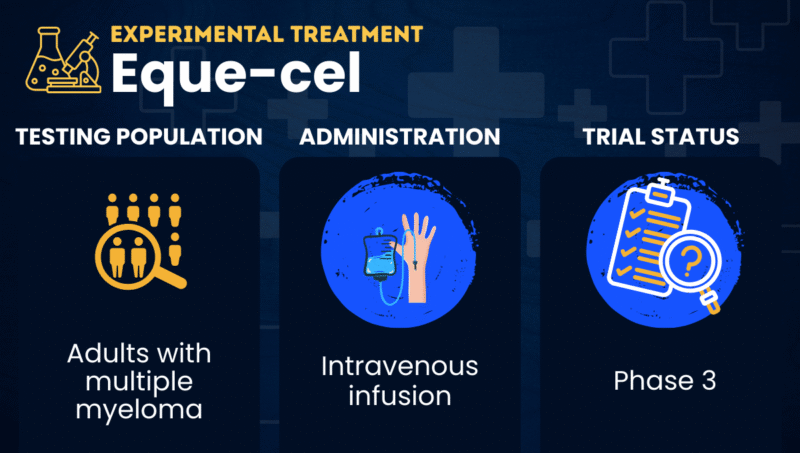
Therapy snapshot
| Treatment name | Equecabtagene autoleucel |
| Administration | Intravenous infusion |
| Clinical testing | Currently in Phase 3 testing |
How will eque-cel be administered in multiple myeloma?
In completed and ongoing clinical trials, the creation and administration of eque-cel involves several steps:
- Cell collection: T-cells are collected from the patient’s blood.
- Cell modification: The T-cells are engineered in a lab to carry the BCMA-targeting CAR.
- Pre-infusion treatment: Patients receive a short round of chemotherapy to reduce immune cell levels, preparing the body for the eque-cel infusion.
- Eque-cel infusion: An intravenous infusion returns the engineered CAR T-cells to the body.
The target dosage of eque-cel in clinical trials is approximately 1 million CAR T-cells per kilogram of body weight.
Eque-cel in multiple myeloma clinical trials
Eque-cel’s approvals in China were supported by the Phase 1/2 FUMANBA-1 trial (NCT05066646), which enrolled 103 participants with relapsed or refractory multiple myeloma (RRMM) who had received at least three prior lines of therapy and were treated with eque-cel. The results showed:
- the vast majority (96%) of participants had at least a partial reduction in myeloma activity after treatment, and nearly three-quarters had a complete response, meaning there was no detectable myeloma activity
- most participants who had previously received a different CAR T-cell therapy had at least a partial response to the therapy
- after a year, 78.8% of participants were alive and had not experienced disease progression
In a three-year follow-up analysis, the median survival without disease progression was about 2.5 years.
Ongoing clinical trials are now aiming to confirm these benefits of eque-cel:
- The Phase 1 FUMANBA-2 study (NCT05181501) involves people with newly diagnosed high-risk multiple myeloma. After three rounds of standard myeloma therapies, participants who are not eligible for a stem cell transplant are receiving eque-cel. Preliminary results from 16 treated participants showed that all responded to the treatment after a median of more than two years. Nearly three-quarters were still alive and had not experienced disease progression after two years.
- The Phase 3 FUMANBA-3 trial (NCT06464991) is comparing eque-cel to standard treatments in people with RRMM who have previously received one or two lines of treatment and did not respond to Revlimid (lenalidomide). The study’s main goal is to evaluate survival without disease progression.
Eque-cel side effects
In FUMANBA-1, the most common side effects of eque-cel included:
- low blood cell counts
- fever
- infection
- cough
- low blood pressure
- vomiting
- diarrhea
- cytokine release syndrome (CRS), a type of whole-body immune reaction
Most cases of CRS were mild or moderate, and about 98% resolved with treatment, but two participants died after developing CRS-related complications. About 15% of participants experienced neurological complications including two patients who had a potentially serious condition called immune effector cell-associated neurotoxicity syndrome. Both of those cases were proven to be treatable.
Rare Cancer News is strictly a news and information website about the disease. It does not provide medical advice, diagnosis, or treatment. This content is not intended to be a substitute for professional medical advice, diagnosis, or treatment. Always seek the advice of your physician or other qualified health provider with any questions you may have regarding a medical condition. Never disregard professional medical advice or delay in seeking it because of something you have read on this website.