
Navigating hair loss, and regrowth, after SCT for multiple myeloma
Reflecting on the hair-raising part of my journey post-stem cell transplant
Written by |

Note: This column describes the author’s own experiences with a stem cell transplant. Not everyone will have the same response to treatment. Consult your doctor before starting or stopping a therapy.
I just got a haircut. Every time I do that, I think about how multiple myeloma affected this one part of my life. The thoughts may not be what you expect.
There’s a tiny penny-pincher in my brain, watching our budget, so for years I went to a cheap chain salon. Cost mattered more than quality. If money were tight, I’d let my hair grow until I couldn’t stand it anymore.
Losing it all changed my thinking.
While many myeloma treatments don’t affect hair drastically, if you have a stem cell transplant (SCT) like I did, expect to lose your hair. The melphalan used in SCT is like a firebomb; it kills the cancer cells but also attacks the follicles.

The impact of hair loss
Some say it’s foolish to fear hair loss, claiming, “It’s only hair.”
True, we are not our bobs and braids, our ponytails and updos. We are not merely blond, brunette, or redhead — or pink, purple, green, or blue, if you’re inclined toward vibrant colors.
But that’s hard to remember when you’re staring at an expanse of bare scalp.
There have been studies on the psychological impact of cancer-related hair loss. Worrying about it is common and nothing to feel foolish about.
How do you get ready for this?
There’s no wrong way to prepare for the day you wake up with hair all over the sheets. Some patients launch a preemptive strike and shave it all off before SCT. Some go wild with Mohawks or bright dye jobs. Others save their locks for wigs, for themselves, or for others in need.
Whatever you feel you can do is the right way to go.
I took a moderate approach, cutting my hair shorter and shorter in the months leading up to my SCT. Right before the stem cell harvest, I got a pixie cut.
I wouldn’t have it for long.
Waiting for the inevitable
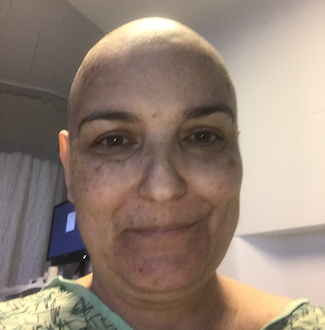
Gina Diamante snaps a photo after the “Big Shave-Off,” Oct. 28, 2019. (Photo by Gina Diamante)
The SCT firebomb has a long fuse. You don’t see or feel it working right away. Thirteen days after getting the melphalan in October 2019, I woke up to find tiny curls scattered all over my pillow. It looked like a lot of hair, but my reflection showed I wasn’t completely bald.
Yet.
I had a choice: let nature take its course or let a nurse shave what remained. Since I didn’t want to keep waking up to hair on my pillow, it was time for the electric razor.
This can be a devastating step for many. Not so much for me. I think the preparation helped. I was also inspired by the example of a former co-worker who lost her hair during breast cancer treatment. She returned to work with a collection of wigs and scarves, and the courage to do without either when she felt like it.
I wasn’t that brave. I had a wig along with my own collection of scarves and hats. I put them all to good use as I recovered from SCT during some very cold winter and spring months.
During that time, my hair slowly but surely grew back.
Getting my hair back post-SCT
After six months, my hair was about the length it had been before it started falling out. Upkeep was minimal.
The only thing I didn’t like was the gray. My doctor gave me permission for a dye job, so as the old commercial says, I washed that gray right outta my hair.
As it grew, I felt my new hair was much better than before. I told people it’s the secret your stylist won’t tell you: Just shave it off and start over!
Like many patients, I got “chemo curls” as my hair grew back.
By August 2021, the curls brushed my shoulders. I’d planned to let my hair keep growing until my second rebirthday in October, but it was too hot in the summer.
It was time to see a stylist.
My first post-SCT haircut was at a fancier — and more expensive — salon than I used to go to. I told my internal penny-pincher I could afford it just this once. But I enjoyed the experience and loved the hairstyle so much that I never went back to my old place.
My columnist profile photo was taken a few hours after that hair appointment.
Perhaps “it’s only hair,” but this splurge makes me happy. It’s too easy to be unhappy when you have cancer, so I try to grab joy wherever I can. It’s strange to say, but if not for losing my hair, I would have missed this little bit of happiness that gives me hope.
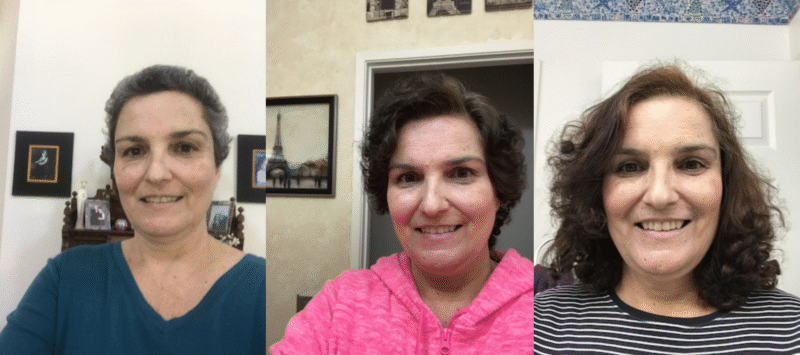
From left, Gina Diamante shows her hair growth six months after stem cell transplant, one year after SCT, and just before her first post-SCT haircut on Aug. 20, 2021. (Photos by Gina Diamante)
Note: Rare Cancer News is strictly a news and information website about the disease. It does not provide medical advice, diagnosis, or treatment. This content is not intended to be a substitute for professional medical advice, diagnosis, or treatment. Always seek the advice of your physician or other qualified health provider with any questions you may have regarding a medical condition. Never disregard professional medical advice or delay in seeking it because of something you have read on this website. The opinions expressed in this column are not those of Rare Cancer News or its parent company, Bionews, and are intended to spark discussion about issues pertaining to rare cancer.



Suzanne Mccracken
You look awesome and thank you for talking about this. This is literally the first time I’ve seen someone talk about the “growing back” part of losing your hair journey.
Again, a huge thank You!
Suzanne