
Anitocabtagene autoleucel for multiple myeloma
 Fact-checked by
 What is anito-cel for multiple myeloma?
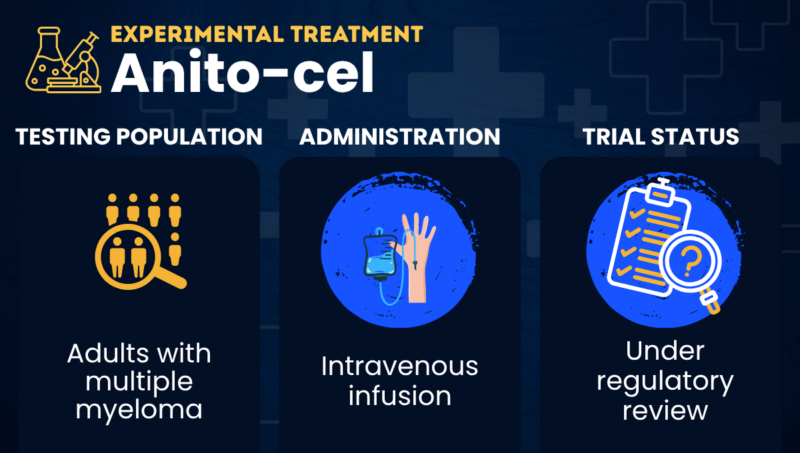
Anitocabtagene autoleucel, or anito-cel, is an experimental CAR T-cell therapy under development for multiple myeloma.
In multiple myeloma, immune cells called plasma cells become cancerous and start growing out of control. While other parts of the immune system, including T-cells, have natural anti-cancer properties, they often can’t effectively slow or stop this growth.
CAR T-cell therapies like anito-cel are manufactured using a patient’s own T-cells, which are engineered in a lab to improve their ability to target and attack cancer cells. This engineering process involves adding a chimeric antigen receptor (CAR) to T-cells.
In the case of anito-cel, the CAR is designed to bind to B-cell maturation antigen (BCMA), a protein found mostly on plasma cells. When returned to the patient’s body via an into-the-vein (intravenous) infusion, the modified CAR T-cells are then expected to recognize and kill cancerous cells harboring this protein.
While there are other CAR T-cell therapies for multiple myeloma, including some that use a BCMA-targeting CAR, the CAR in anito-cel has a distinctive molecular structure called a D-domain binder. Preclinical studies suggest that this structure may enhance efficacy and reduce side effects.
Kite, a Gilead company, and Arcellx are collaborating to develop anito-cel. Gilead recently announced plans to purchase Arcellx to facilitate this partnership.
The U.S. Food and Drug Administration has agreed to review an application from the companies requesting the approval of anito-cel for multiple myeloma. A decision is expected in December.
Therapy snapshot
| Treatment name | Anitocabtagene autoleucel |
| Administration | Intravenous infusion |
| Clinical testing | Under regulatory review in the U.S. |
How will anito-cel be administered in multiple myeloma?
Anito-cel is designed to be administered via a single intravenous infusion after a short round of chemotherapy that’s given to wipe out existing immune cells and prepare the body to receive the engineered T-cells.
In ongoing Phase 2 and Phase 3 clinical trials testing anito-cel in people with multiple myeloma, a target dose containing about 115 million CAR T-cells is being used. However, it’s still unclear if this will be the selected dose if the therapy is ultimately approved.
Anito-cel in multiple myeloma clinical trials
Several clinical trials are assessing the safety and efficacy of anito-cel in patients with multiple myeloma:
- In a Phase 1 proof-of-concept trial (NCT04155749), 38 participants received the therapy at one of two dose levels (about 115 million or 300 million CAR T-cells). Participants had relapsed or refractory multiple myeloma (RRMM), meaning their cancer had come back or stopped responding to treatment, and they had previously received at least three lines of therapy. All participants responded at least partially to treatment. Additionally, a median of 30.2 months (about 2.5 years) passed before they experienced disease progression or died. Efficacy results were similar in high-risk subgroups. Follow-up is ongoing.
- The Phase 2 iMMagine-1 trial (NCT05396885) includes 117 participants with RRMM who received at least three prior lines of therapy. All received a dose of approximately 115 million CAR T-cells. After a median follow-up of about a year, 97% of participants had at least a partial response to treatment. An estimated 79% of participants were alive and had not experienced disease progression in the year after the infusion.
- The Phase 3 iMMagine-3 (NCT06413498) is testing anito-cel against standard-of-care treatments. It will enroll about 450 participants with RRMM who have previously received one to three lines of treatment. The primary goal of the study is to assess the effects of treatment on time until disease progression or death in the two treatment groups.
As these studies conclude, participants may be invited to participate in a long-term follow-up study (NCT05041309) for continued observation.
Additionally, a small Phase 2 study in Spain, GEM-AnitoFIRST (NCT07045909), is testing anito-cel in newly diagnosed patients with multiple myeloma. The trial is led by independent investigators and aims to evaluate the safety and efficacy of anito-cel administered after induction therapy.
Anito-cel side effects
In iMMagine-1, the most common side effects reported in patients receiving anito-cel included:
- abnormal blood cell counts, including low levels of red blood cells (anemia), platelets (thrombocytopenia), and a type of white blood cell called neutrophils (neutropenia)
- fatigue
- low antibody levels in the blood, which can increase the risk of infections
- headache
- low blood levels of certain minerals, including phosphate and potassium
- nausea
- diarrhea
- high blood pressure
- infections
- cytokine release syndrome (CRS), a whole-body inflammatory condition
While 85% of trial participants experienced CRS, all but one case was mild or moderate.
Neurological complications, including a condition called immune effector cell-associated neurotoxicity syndrome (ICANS), sometimes occur after CAR T-cell therapy. All cases of ICANS during the trial, which affected 8% of participants, resolved, and no other neurological concerns emerged.
Rare Cancer News is strictly a news and information website about the disease. It does not provide medical advice, diagnosis, or treatment. This content is not intended to be a substitute for professional medical advice, diagnosis, or treatment. Always seek the advice of your physician or other qualified health provider with any questions you may have regarding a medical condition. Never disregard professional medical advice or delay in seeking it because of something you have read on this website.