
Abecma (idecabtagene vicleucel) for multiple myeloma
 Fact-checked by
 What is Abecma for multiple myeloma?
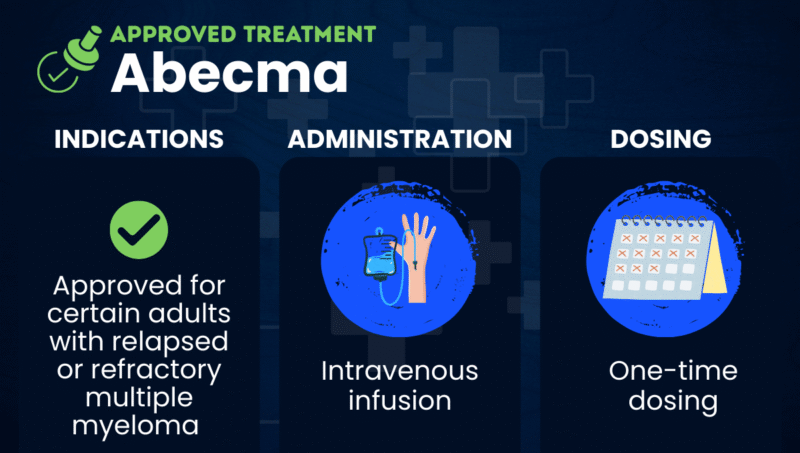
Abecma (idecabtagene vicleucel) is an FDA-approved CAR T-cell therapy for certain adults with multiple myeloma whose cancer has returned (relapsed) or has not responded (refractory) to prior treatments.
In multiple myeloma, a type of blood cancer, immune cells called plasma cells grow out of control in the bone marrow — the spongy tissue inside bones where blood cells are made.
Abecma aims to reprogram immune system components to help the body more effectively attack myeloma cells. It uses the patient’s own T-cells, immune cells that can kill harmful cells, and modifies them to specifically target the cancer.
After being collected, patients’ T-cells are engineered in a lab with a chimeric antigen receptor (CAR) that enables them to more efficiently recognize and destroy myeloma cells. The CAR used in Abecma is specifically designed to bind to a protein called B-cell maturation antigen (BCMA), which is found at high levels on myeloma cells.
The modified T-cells are then returned to the patient through a one-time intravenous (into-the-vein) infusion, where they seek out and attack myeloma cells carrying BCMA.
Abecma was developed by Bristol Myers Squibb in collaboration with 2seventy bio, which was later acquired by Bristol Myers Squibb.
Therapy snapshot
| Brand name | Abecma |
| Chemical name | Idecabtagene vicleucel |
| Usage | Used to treat certain adults with relapsed or refractory multiple myeloma |
| Administration | Intravenous infusion |
Who can take Abecma?
In the U.S., Abecma is approved for adults with relapsed or refractory multiple myeloma who have received at least two prior lines of therapy. Previous treatment must have included a proteasome inhibitor, an immunomodulatory drug, and an anti-CD38 antibody.
Abecma is also approved in the European Union for similar use.
The prescribing information lists no formal contraindications or reasons not to use Abecma. However, Abecma carries a boxed warning for potentially life-threatening complications. These include inflammatory and immune reactions, serious nervous system problems, prolonged low blood cell counts, and the possible development of other blood cancers.
How is Abecma administered?
Abecma is an individualized therapy that must be made specifically for each patient before it can be given at a certified treatment center. The recommended dose range is 300 million to 510 million CAR T-cells per infusion.
The treatment process includes several steps:
- Cell collection: T-cells are collected from a patient’s blood through a process called apheresis, which typically takes about two to six hours.
- CAR T-cell creation: The collected T-cells are engineered in a lab to carry a specialized CAR that enables them to more efficiently recognize and destroy cancer cells. This step usually takes about four weeks, though timing may vary.
- Pre-treatment chemotherapy: A few days before receiving Abecma, patients receive a three-day short course of chemotherapy. This helps prepare the body for receiving the newly engineered T-cells.
- Abecma infusion: Two days after chemotherapy, patients receive a one-time intravenous infusion. The dose may be given in one or more infusion bags, and each bag typically takes up to about 30 minutes. Before the infusion, patients may receive medications to prevent immune reactions.
- Monitoring: Patients are monitored daily for potential side effects in the week after the infusion. They should also make plans to stay close to their treatment center for at least two weeks after receiving Abecma.
Abecma in clinical trials
Abecma’s approval for multiple myeloma was supported by data from two key clinical trials:
- In the Phase 2 KarMMa trial (NCT03361748), adults who had received at least three prior lines of treatment — including a proteasome inhibitor, an immunomodulator, and an anti-CD38 antibody — received a single infusion of Abecma. Among participants who received approximately 300 million to 460 million CAR T-cells, about 72% experienced at least a partial response to treatment.
- The Phase 3 KarMMA-3 trial (NCT03651128) compared Abecma with standard-of-care myeloma treatments in adults who had received two to four prior lines of therapy, including a proteasome inhibitor, an immunomodulator, and an anti-CD38 antibody. Patients treated with Abecma lived for a median of 13.3 months after the infusion without experiencing disease progression — significantly longer than the median of 4.4 months seen in the standard-of-care group.
Abecma side effects
The most common side effects of Abecma include:
- fever
- cytokine release syndrome
- low levels of antibodies in the blood, which may increase infection risk
- infections, including upper respiratory tract infections and viral infections
- musculoskeletal pain
- fatigue
- low blood pressure
- increased heart rate
- diarrhea
- nausea
- headache
- chills
- neurological problems
- swelling
- shortness of breath
It is also common for people who receive Abecma to have low blood cell counts.
Abecma carries a boxed warning for serious and potentially life-threatening complications, including:
- cytokine release syndrome (CRS), a type of systemic inflammatory response
- neurological complications, including immune effector cell-associated neurotoxicity syndrome (ICANS), an inflammatory condition that can occur with or without CRS
- hemophagocytic lymphohistiocytosis and macrophage activation syndrome, which can cause organ failure from uncontrolled immune activity
- prolonged or recurrent low blood cell counts, which can cause bleeding and infections
- secondary blood cancers
Patients should not receive Abecma if they have an active infection or inflammatory condition, as this may increase the risk of severe immune reactions. Doctors closely monitor patients after treatment and may use supportive care or medications to manage CRS or neurologic side effects.
In the Phase 3 KarMMA-3 clinical trial, which compared Abecma with standard myeloma treatments, a higher proportion of patients in the Abecma group died within nine months after randomization. Some deaths occurred before patients received the infusion. Patients should discuss the potential risks and benefits of treatment with their healthcare provider. Abecma may also cause allergic reactions, infections, abnormal blood counts, and low antibody levels, which should all be addressed appropriately.
Abecma is not typically recommended for use during pregnancy. Patients who are pregnant or planning to become pregnant should discuss the potential risks with their healthcare provider.
Rare Cancer News is strictly a news and information website about the disease. It does not provide medical advice, diagnosis, or treatment. This content is not intended to be a substitute for professional medical advice, diagnosis, or treatment. Always seek the advice of your physician or other qualified health provider with any questions you may have regarding a medical condition. Never disregard professional medical advice or delay in seeking it because of something you have read on this website.